|
Al Gomes and A. Michelle of Big Noise consulted
on the navigation and organization of Chicago's Official
Website (1998-2002) including all features and sections
of the site, and designed META code for maximum search engine
rankings.
Rhino Records also enlisted
Al and A. Michelle to assist with part of the publicity
and promotion campaign for the reissuing of Chicago's classic
catalog.
Click here to enter the website:
www.chicagotheband.com
The classic songs, latest news, tour dates, photo archive,
contact info, CD purchase, fan club,
forum, bio, merchandise, press and more
Rhino Reissue Series
Bill Champlin of Chicago's appearance
on Big Noise CD

Rhino Reissues Chicago Catalog
CHICAGO was once one
of the hippest rock acts signed by Columbia Records in the
late 1960's, along with Santana, Janis Joplin and Blood,
Sweat & Tears. A few years ago, the rights to the band's
catalog reverted from Sony Music back to the group, and
their seminal albums remained under-represented on CD. This
has finally changed with Rhino
Records reissuing Deluxe Editions of Chicago's
14 albums originally released on Columbia, from 1969's
Chicago Transit Authority up through 1980's.....well,
if you know the band, you know it's Chicago XIV.
Chicago ranks as one of the best-loved and most successful rock groups ever in music history. Their career, which continues to interwine artistic innovation and commercial success, spans over 45 years and includes worldwide sales exceeding 122 million records, five consecutive #1 albums - and 35 Top 40, 21 Top 10, and 5 #1 singles (the only American rock band to chart in the Top 40 for five consecutive decades). Their hits have given the band a combined 13 platinum and 19 gold albums, and five gold singles.
And now that all 14 Columbia albums are put out, Rhino has released a five-CD and one-DVD box set which spans, for the first time ever, their entire career.
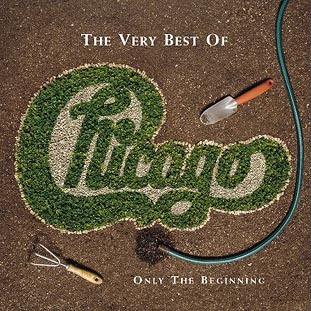
After launching a double-CD Greatest Hits package, The Very Best Of Chicago: Only The Beginning, with a TV ad campaign in 2002, Rhino got down to business with the release of Chicago Transit Authority, Chicago (a.k.a. Chicago II) and Chicago III. The new CDs are mastered from the original master tapes for the first time ever, according to Rhino, and carry new, deluxe 20-page booklets, with full annotation, new liner notes and rare photos from the archives.
The one thing the first three
reissues do not have is unreleased bonus tracks, but it
wasn't for lack of trying. As old fans remember, one of
Chicago's trademarks was releasing multi-LP albums at a
time when few rock groups were doing so. Boldly, their first
three records were all two-LP sets (and their fourth album
was a four-LP set).
Project Supervisor David McLees of Rhino tells Ice, "These were double albums, and they used everything they had at the time. No amount of due diligence would uncover bonus tracks, because they don't exist. There are live things we could've added, but we felt that would've been sort of sacrilegious." Actually, Rhino found a way to slightly embellish one of the albums: the single versions of "Make Me Smile" and "25 or 6 to 4" have been added to Chicago.
"On the first three, and the
whole catalog, we thought there was huge opportunity to
develop packaging," McLees says, pointing out that some
of the band's '90s reissues on its own Chicago Records imprint
carried only "two-page booklets. We're going to 20-page
booklets complete with the lyrics plus liner notes by David
Wild, who did new interviews with most of the band members.
The original LPs were gatefold records with extra packaging,
and we're trying to reproduce those elements. And we're
not doing them in jewel boxes initially, but kind of 'digi-smart-paks.'
The good news for fans is that all subsequent reissues, from Carnegie Hall onwards, feature unreleased bonus tracks from the vaults...what McLees terms "juicy bonus material."
"But most importantly, the catalog was never mastered from the original master tapes, so this is the first time that will occur." These albums have been issued on CD twice before: in the early '80s by then CBS Records and in the '90s on Chicago Records. Jeff Magid, former production chief for Geffen Records, handled the mastering this time around.
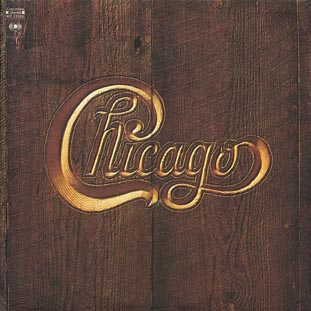
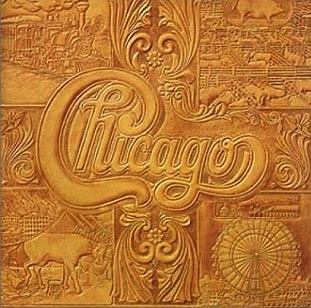
Chicago's next album was the
overly ambitious Chicago at Carnegie Hall, and that
four-LP set is now reissued on CD. Following that was Chicago
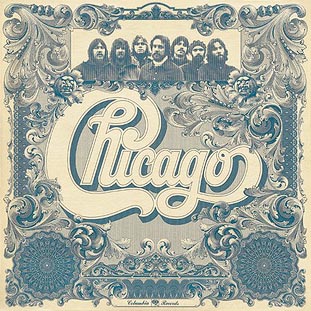
V (their biggest Columbia album), Chicago VI,
Chicago VII, and Chicago VIII.
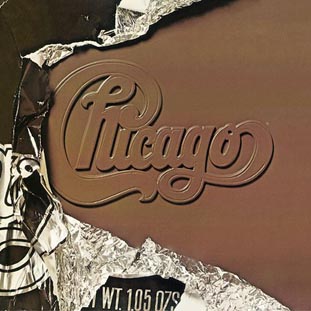
Chicago X was the first of Chicago's albums to be certified platinum, selling 1 million copies in just three months. It includes Chicago's first #1 Billboard single, 'If You Leave Me Now.' Chicago won the Grammy for Best Pop Vocal Performance by a Duo, Group or Chorus and the chocolate-coated artwork also took the Grammy for Best Album Cover. Chicago X now features 2 previously bonus tracks including the first-ever recorded version of 'I'd Rather Be Rich.'
The platinum-plus Chicago XI features the Top 5 power ballad 'Baby, What A Big Surprise,' and the standout single 'Take Me Back to Chicago.' Chicago XI is now expanded with 2 previously unreleased rehearsal takes: 'Paris' and 'Wish I Could Fly.'
The final reissues include: Hot Streets, the first album recorded after the death of Terry Kath (and the first Chicago album to not include a numeral in the title). It includes the bonus track 'Love Was New' with an alternative vocal. Chicago 13 features the bonus tracks 'Closer to You' and an alternate mix of the hit 'Street Player.' Chicago XIV, their final release for Columbia includes the unreleased tracks 'Doin' Business,' 'Live It Up,' and 'Soldier of Fortune.'
Chicago: The Box
And now that all 14 Columbia albums are put out, Rhino has released a five-CD/one-DVD box set which spans their entire career. In the early 1980s, Chicago signed to Warner Bros. Records, and the group's previous box set, Group Portrait (from 1991), only covered only their Columbia material.
Chicago: The Box is a definitive look at
this remarkable band, and the set features full album versions,
single remixes, greatest hits, rare performance footage,
band favorites and more. Produced by Chicago with
Rhino's David McLees and Gary Peterson, this collection
charts the band's origins in Windy City bars to a powerhouse
group playing before sold-out stadiums.
The collection also includes a bonus DVD with incredible rare live performances from the Aerie Crown Theatre in 1972, along with a promotional film made for the release of Chicago 13. Also included is a deluxe book loaded with track-by-track information, archival photos, insightful essays by Phil Gallo and A. Scott Galloway, and testimonials from Paul Shaffer, Phil Ramone, Roy Bittan, Tom Cuddy, and James Newton Howard. The box also includes new variations on the band's signature logo designed by Rhino's Grammy award-winning VP of Creative Services, Hugh Brown.
Simply put, this is THE definitive Chicago collection for the ages, for fans of all ages.
Chicago's visibility
continues to be high from their sold-out tour dates and
an appearance on the 56th Annual Grammy Awards to celebrate
the induction of Chicago Transit Authority into the Grammy
Hall of Fame.
Official Rhino Chicago Reissue Site
with complete info on all the CDs and Box Set
Chicago
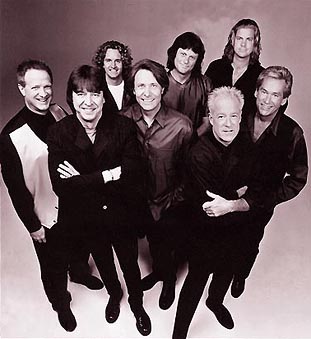
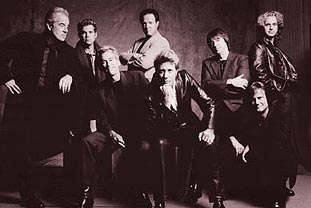
Robert Lamm (1967--present): vocals, keyboards, percussion
Terry Kath (1967--1978): vocals, guitar, bass, percussion
Peter Cetera (1967--1985): vocals, bass, guitar
Danny Seraphine (1967--1990): drums, percussion,
drum programming, vocals
Lee Loughnane (1967--present): trumpet, flugelhorn
percussion, vocals
James Pankow (1967--present): trombone, percussion, vocals, most brass arrangements
Walter Parazaider (1967--present): woodwinds, percussion, vocals
Laudir De Oliveira (1973--1980): congas, percussion, vocals
Donnie Dacus (1978--1980): vocals, guitar
Chris Pinnick (1980--1984): guitar
Bill Champlin (1981--2008): vocals, keyboards, guitar
Jason Scheff (1985--present): vocals, bass
DaWayne Bailey (1986--1994): guitar, vocals
Tris Imboden (1990--present): drums, harmonica
Bruce Gaitsch (1995): guitar
Keith Howland (1995--present): guitar
Click here to enter their official website:
www.chicagotheband.com
The classic songs, latest news, tour dates, photo archive,
contact info, CD purchase, fan club,
forum, bio, merchandise, press and more
Bill Champlin of Chicago's appearance
on Big Noise CD
Home >> Artists
A-Z >> Chicago
Home >> Big
Noise Hall of Fame >> Chicago
|